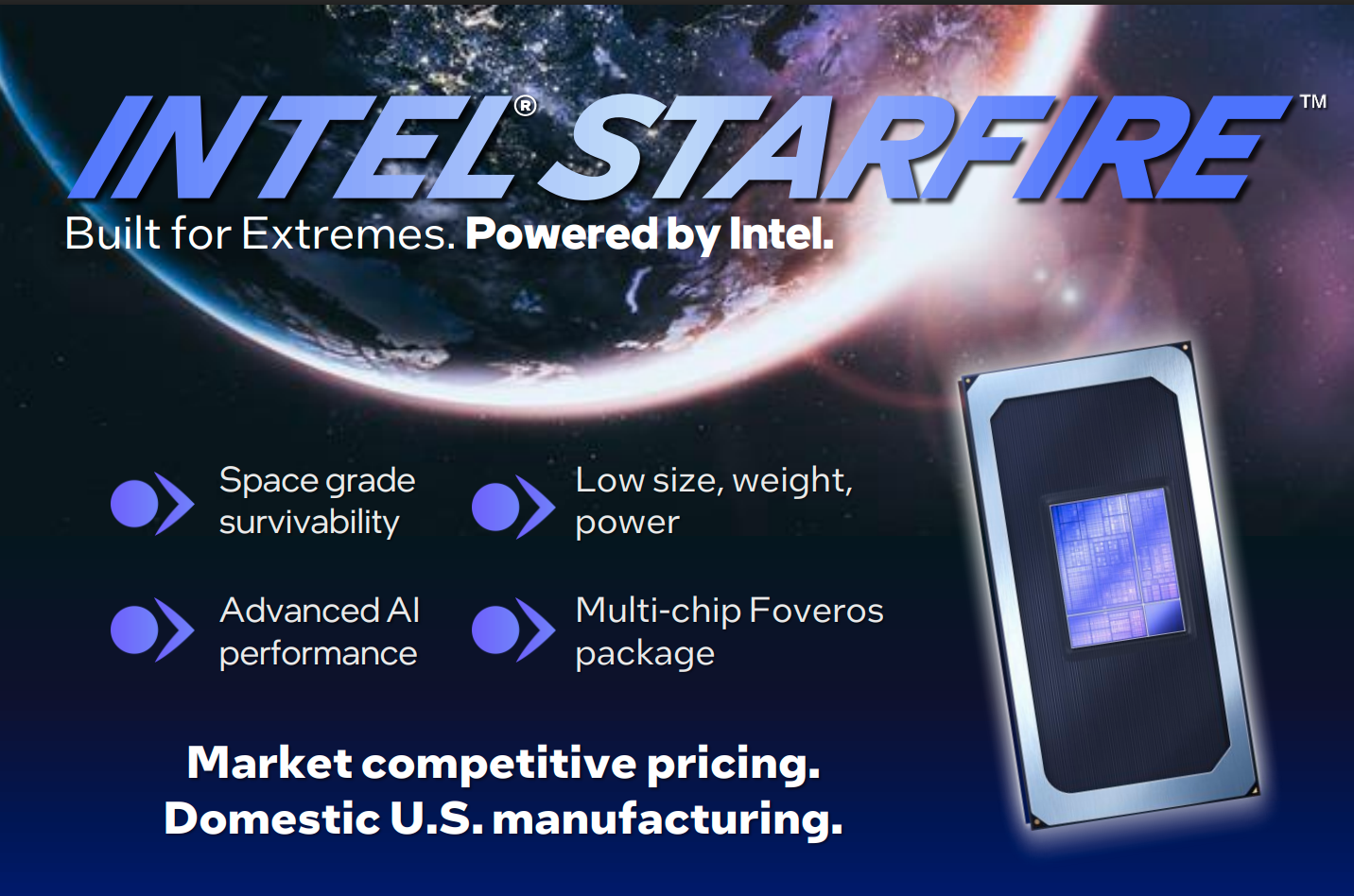
Intel has unveiled a new aerospace-grade AI chip called Starfire. Built on Intel’s 18A process node, the chip features eight cores and carries a rated operational lifespan of ten years. It supports use in orbital data centers. However, Starfire is not a consumer product. Intel has designed it exclusively for the US government and authorized US defense contractors. Full product details are available in Intel’s official Starfire product brief.
Two Configurations: Low-Power and High-Performance
Starfire ships in two configurations: a low-power variant and a high-performance variant. Both use an eight-core design comprising four P-cores and four LPE cores. The low-power variant runs P-cores at 1 GHz and LPE cores at 0.85 GHz. The high-performance variant raises P-cores to 3.1 GHz and LPE cores to 2.1 GHz. Both variants use Intel Panther Lake 4 Xe3 graphics.
Radiation Hardening and Extreme Temperature Range
The chip provides radiation protection including TID, SEL, and SEE hardening. It operates across a temperature range of minus 55 degrees Celsius to 125 degrees Celsius. Connectivity includes twelve PCIe Gen 4 lanes and support for LPDDR5 and DDR5 memory. Intel backs Starfire with a ten-year warranty.
Up to 75 TOPS of AI Compute Performance
In terms of compute performance, the low-power Starfire delivers 45 TOPS. The high-performance model reaches 75 TOPS. Multiple chips can be integrated to increase total system performance, though that naturally raises power consumption. The optimal configuration depends on the specific mission requirements.
Availability: US Government and Authorized Contractors Only
Starfire is not available on the commercial market. According to Intel, the chip is intended for the US government, authorized US defense contractors, and approved allied nation agencies. Its radiation hardening and extreme temperature tolerance suit it for the harsh conditions of orbital deployment. Like most chips in this category, Starfire falls under strict US government export controls.
Intel has a long history of co-developing specialized chips with the US Department of Defense. Products in this category are typically restricted to authorized defense applications. Civilian buyers and unauthorized entities cannot obtain them.
Support Our Threat Intelligence
If you find our technology report and cybersecurity news helpful, consider supporting our work.
 Buy Me a Coffee
PayPal
Buy Me a Coffee
PayPal