In February, Micron announced what it called the world’s first PCIe 6.0 solid-state drive, the Micron 9650. That data-center-grade SSD reaches sequential read speeds of up to 28,000 MB/s. Like all high-performance storage at this tier, it targets data center workloads, with a particular focus on AI infrastructure. Now Samsung has entered the PCIe 6.0 data center arena with a drive of its own.
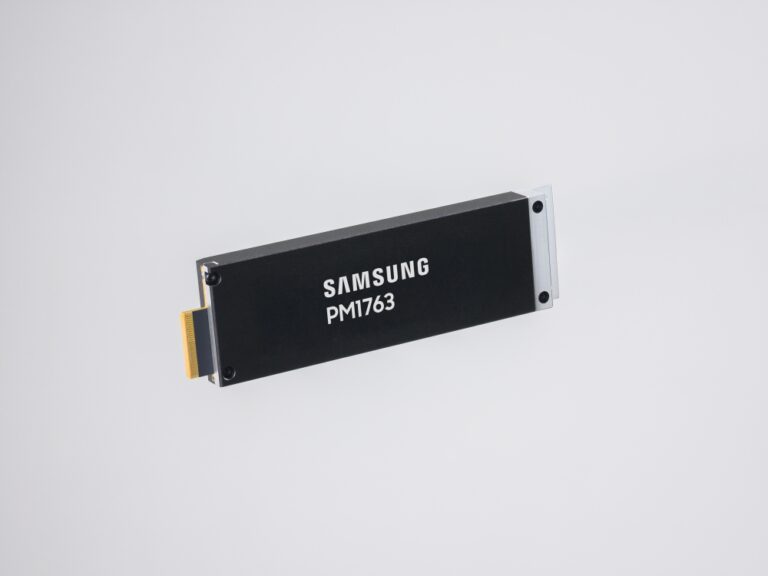
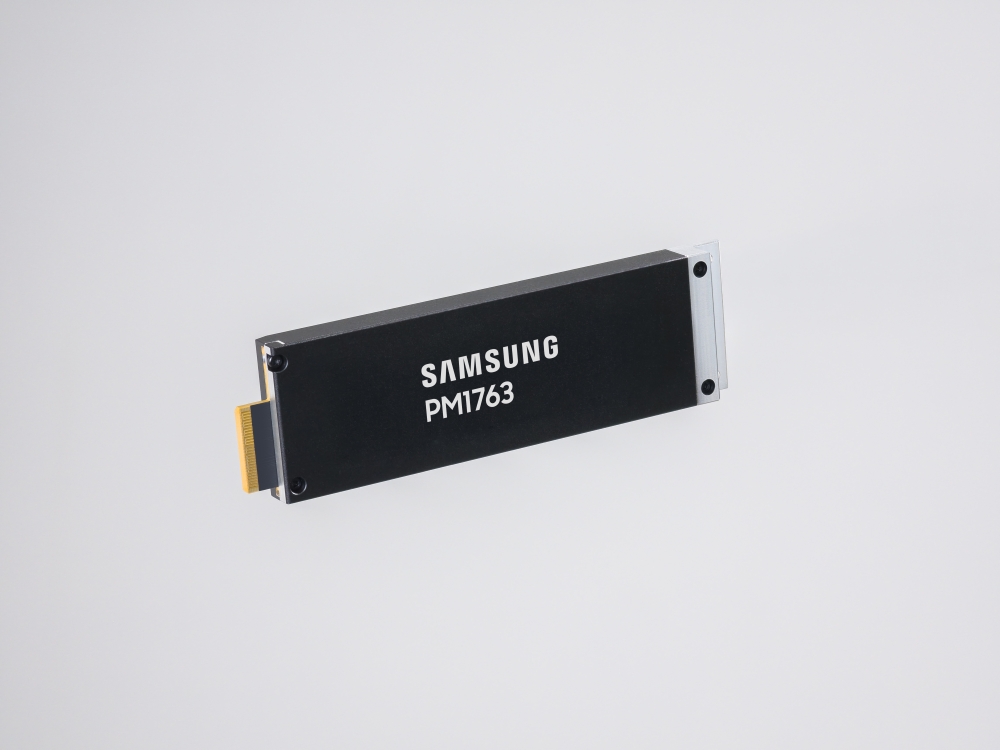
Samsung has begun mass production of the PM1763, its latest enterprise NVMe SSD built on the PCIe 6.0 interface. The most significant upgrade from the PM1753 is the new interface generation. Samsung also paired it with a more powerful controller. As a result, the PM1763 achieves sequential read speeds of 28,400 MB/s.
Capacities, Speeds, and Target Market
The PM1763 targets data centers, workstations, and enterprise environments. It is available in 4 TB, 8 TB, and 16 TB capacities. These peak figures apply to the 16 TB variant. Sequential reads reach 28,400 MB/s while sequential writes reach 21,900 MB/s. The 4 TB and 8 TB models offer slightly lower throughput.
AI Transfer Speed and Energy Efficiency
Samsung states that the drive can transfer up to 40 GB of AI data in just 1.4 seconds. In addition, the PM1763 delivers an energy efficiency improvement of 1.8 times over the PM1753. Data centers can therefore achieve higher performance while simultaneously reducing power consumption.
Sustained Peak Performance Through Direct Chip Cooling
Consumer SSDs commonly throttle under sustained thermal load. Enterprise drives face similar thermal limits. However, Samsung addresses this in the PM1763 through direct chip cooling technology and dedicated optimization for liquid-cooled server environments. Samsung claims the PM1763 can sustain peak performance continuously whenever workloads demand it.
Form Factors: E1.S, E3.S, and U.2
The PM1763 ships in three form factors: E1.S, E3.S, and U.2. However, the U.2 variant supports only the PCIe 5.0 interface. For deployments that require the full PCIe 6.0 bandwidth, data centers will likely rely on the E1.S and E3.S variants. Using the U.2 version would cut performance by nearly 50 percent.
Support Our Threat Intelligence
If you find our technology report and cybersecurity news helpful, consider supporting our work.
 Buy Me a Coffee
PayPal
Buy Me a Coffee
PayPal