GitHub increasingly resembles a warehouse stocked with ready-made exploits, yet nearly half of all new publications fail to hold up under scrutiny. Researchers at VulnCheck have identified a sharp surge in fabricated and AI-generated code being passed off as functional exploits for known vulnerabilities. By mid-August 2026, the company had reviewed more than 17,800 such publications – a figure already representing 87% of its total output for all of 2025.
A Sharp Decline in Verified Exploits
For comparison, VulnCheck reviewed roughly 20,000 publicly available exploits and technical write-ups over the course of last year. GitHub repositories account for between 14% and 20% of all the code that comes across the company’s radar. In recent years, approximately 51% of new exploits sourced from GitHub passed verification, but in 2026, that figure dropped to roughly 45%.
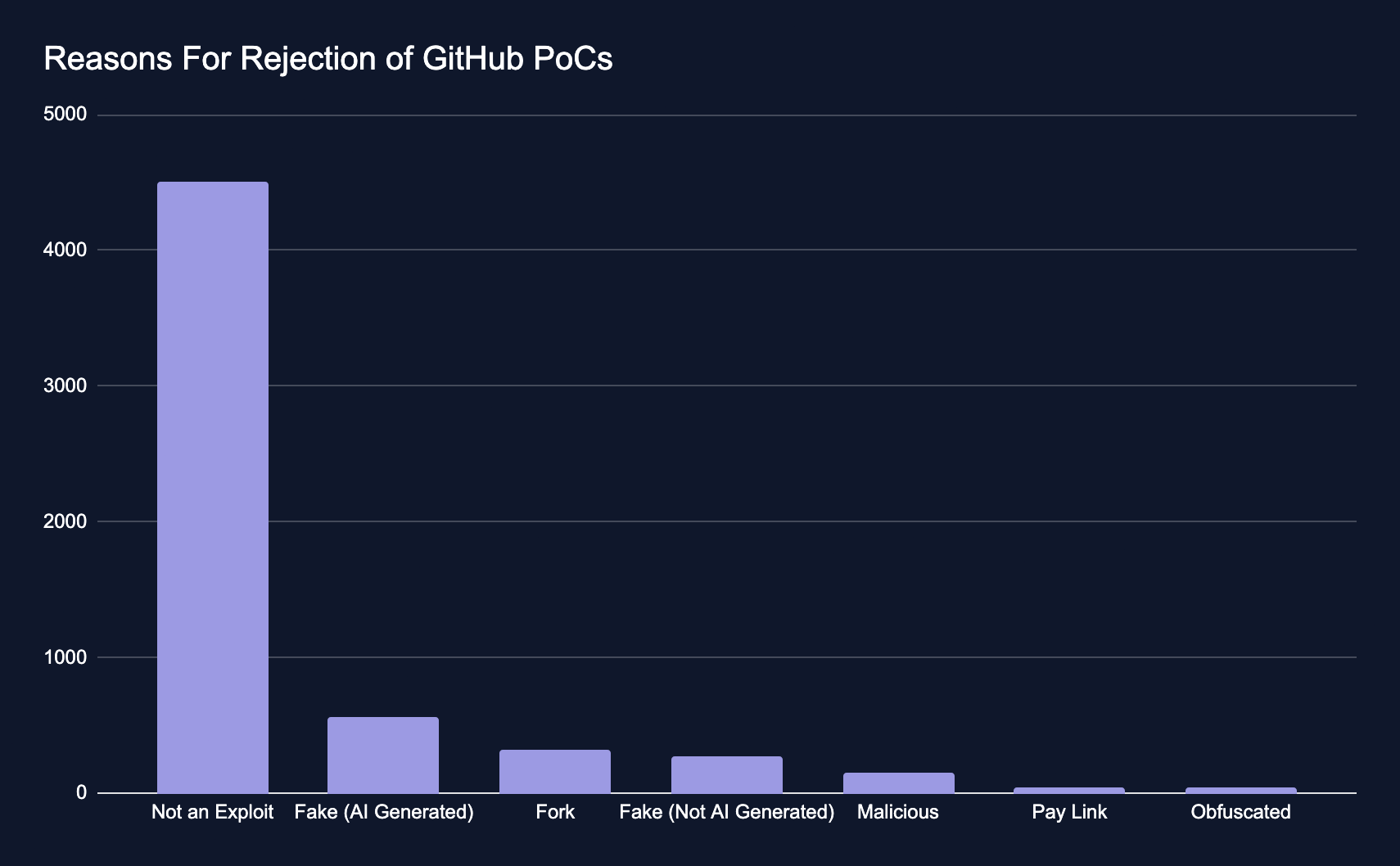
Most Rejected Repositories Contain No Actual Exploit
Most frequently, a rejected repository doesn’t contain any working exploit at all. Instead of functional code, authors publish a vulnerability description, a skeleton template, a system-checking script, or simply a README file. Many of these pages are AI-generated, characterized by lengthy descriptions, decorative formatting, and emoji, paired with an almost complete absence of technical substance. In second place come outright fake exploits – code that appears convincing on the surface but is fundamentally incapable of performing the actions it claims to.
Case Study: Fake Exploits for a Critical libssh2 Flaw
A telling example centers on CVE-2026-55200 (rated 10.0 Critical), a vulnerability in the libssh2 library. The flaw allows memory corruption via a specially crafted SSH packet, potentially enabling remote code execution. After a genuine proof-of-concept was published, a wave of AI-generated copies quickly followed. One such repository promised to deliver a reverse shell, yet its code never actually performed the operations required to exploit the underlying vulnerability at all.
Some Fakes Are Actively Malicious
Certain fabrications prove far more dangerous than merely useless code. VulnCheck regularly encounters malicious repositories disguised as vulnerability-scanning tools. In one documented case, an attacker took VulnCheck’s own scanner for CVE-2023-36845 (rated 9.8), inserted a hidden command to download a malicious file, and re-uploaded the modified tool to GitHub under a new listing. In other instances, malicious code was concealed within multiple layers of Base64-encoded strings and executed via the `exec` function.
Recommendations for Researchers
VulnCheck’s specialists advise avoiding obfuscated code that resists normal inspection, along with any repository requesting cryptocurrency payment in exchange for a supposedly complete exploit. According to VulnCheck’s own data, GitHub has removed nearly every malicious repository the company has flagged, typically within a week. The sheer increase in publication volume, on its own, no longer signals a genuine rise in working exploits. AI has meaningfully expanded the volume of code circulating around newly disclosed vulnerabilities – but alongside legitimate research, it has also brought a flood of empty templates, fabrications, and outright malware.
Support Our Threat Intelligence
If you find our technology report and cybersecurity news helpful, consider supporting our work.
 Buy Me a Coffee
PayPal
Buy Me a Coffee
PayPal