A severe architectural vulnerability has been identified within the Linux kernel, designated as CVE-2026-46333, which poses an especially alarming threat to system administrators: an unprivileged local actor on a vulnerable host can successfully read files strictly reserved for the root user, including private host SSH keys and the /etc/shadow repository containing password hashes. The exploit chain, structurally christened ssh-keysign-pwn, has already seen its functional proof-of-concept (PoC) code disseminated into the public domain.
Crucially, this flaw does not undermine OpenOpenSSH itself nor does it arise from a misconfiguration of the SSH daemon; rather, it subverts the foundational access-validation mechanics of the Linux kernel. The bug resides within the ptrace orchestration logic used by the kernel to mediate process-to-process inspection requests. Under standard operational paradigms, these security checks are designed to strictly prohibit a low-privilege task from interrogating an elevated process. Within CVE-2026-46333, however, this validation sequence collapses during a transient micro-window at process termination.
The vulnerability stems from the precise chronological order in which the Linux kernel tears down process resources. During the final phases of execution termination, the kernel releases the task’s memory abstractions while leaving its file descriptor tables temporarily intact. Within this brief interstice, the internal __ptrace_may_access() function short-circuits its validation routine because the target task no longer possesses an active memory context (mm_struct), despite still retaining file descriptors linked to highly sensitive resources. An adversary can weaponize this race condition, exploiting the pidfd_getfd() system call to surreptitiously hijack the active file descriptor.
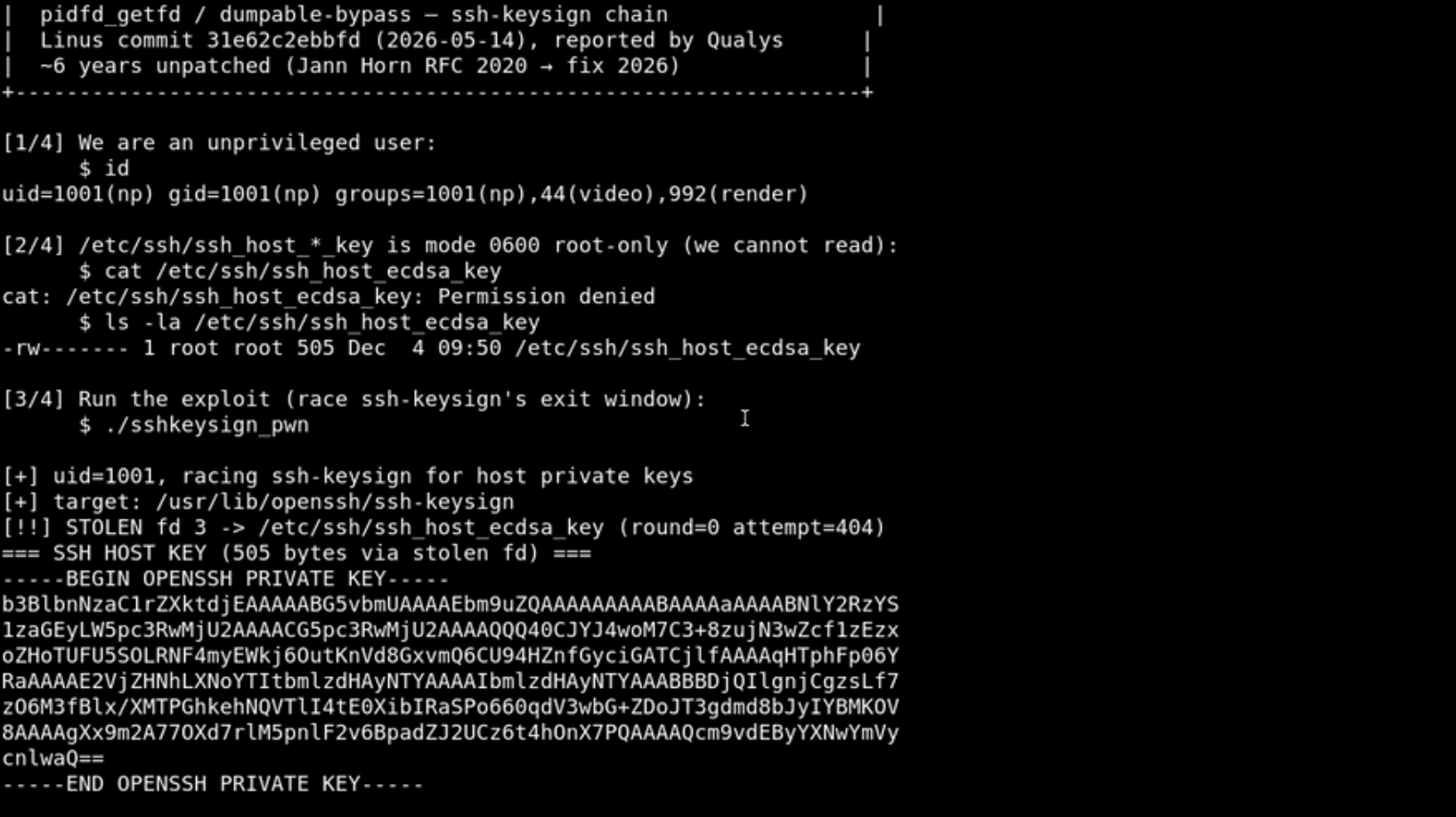
In practice, the exploitation vector is highly pragmatic and deeply hazardous. An attacker maintaining basic local access iteratively spawns and terminates targeted binaries, aiming to successfully intercept the narrow execution window of a privileged helper utility. The published ssh-keysign-pwn demonstration asset highlights two distinct vectors: leveraging the ssh-keysign binary to exfiltrate private host keys from /etc/ssh/ssh_host_{ecdsa,ed25519,rsa}_key, or abusing chage -l <user> to secure a read stream of /etc/shadow. Debian has already updated its vulnerability ledger to reflect the upstream kernel fix alongside links to the public exploit repository.
The paramount systemic risk does not solely center on immediate local root elevation, but rather on the exfiltration of long-term cryptographic secrets whose lifecycles routinely outlast the compromised server itself. A stolen host private SSH key enables adversaries to orchestrate sophisticated machine-in-the-middle (MitM) positioning or spoof valid server identities prior to key rotation. Similarly, harvested password hashes from /etc/shadow can be transferred to external cracking rigs, allowing offline brute-force campaigns devoid of network-layer indicators. Should any of these credentials or cryptographic keys be reused across adjacent network enclaves, a localized host compromise instantly escalates into a lateral threat across the wider enterprise fabric.
The defining remediation was merged into the upstream Linux kernel source on May 14, 2026, via commit 31e62c2ebbfd. Prior to this structural correction, all running kernels lacking the patch were deemed vulnerable, prompting downstream Linux distributions to aggressively backport the fix into their respective stable branches. Red Hat has characterized CVE-2026-46333 as an illegitimate local data-exposure vector, while Debian’s advisory officially references both the upstream engineering patch and the weaponized public PoC repository.
Systems administrators are strongly implored to upgrade their kernel architectures via standard distribution repositories and initialize a full system reboot if automated live-patching frameworks are unavailable. Post-remediation, security teams should perform access audits on /etc/shadow, review active local user accounts, and proactively rotate host SSH keys on critical production infrastructure—particularly across shared computing assets. Restricting local terminal access significantly narrows the exposure surface, but it cannot substitute for a comprehensive kernel update, as the exploit requires nothing more than an established, low-privilege foothold upon the system.
Support Our Threat Intelligence
If you find our technology report and cybersecurity news helpful, consider supporting our work.
 Buy Me a Coffee
PayPal
Buy Me a Coffee
PayPal