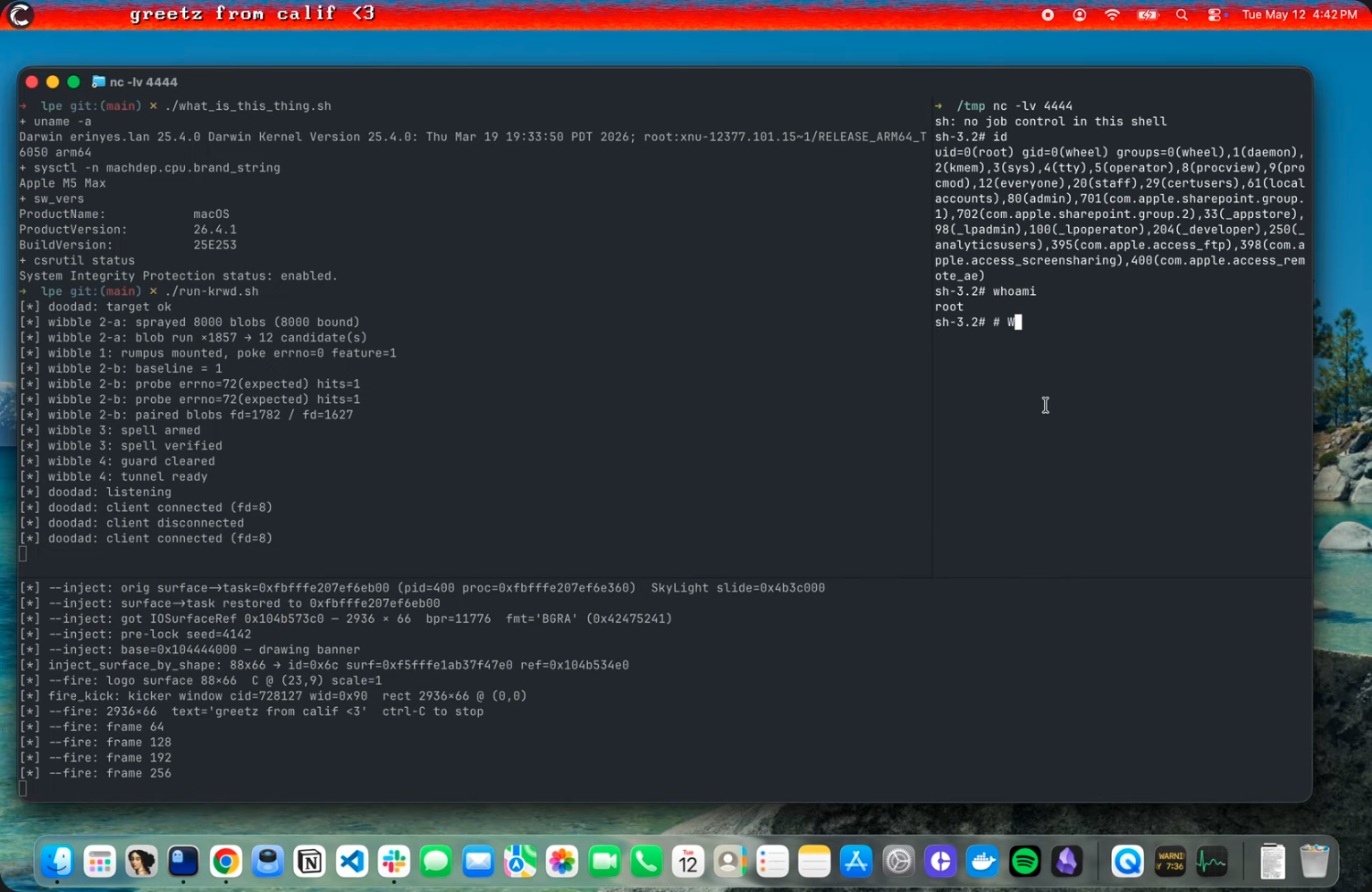
The cyber-intelligence collective Calif has announced the synthesis of the premier public exploit capable of inducing memory corruption within the macOS kernel architecture powering Apple hardware equipped with the state-of-the-art M5 silicon. The architects of the project assert that they have successfully subverted MIE (Memory Integrity Extension), a hardware-enshrined protective primitive that Apple spent half a decade engineering and championed as the definitive security cornerstone for its nascent M5 and A19 SoC architectures.
The researchers disclosed that they personally delivered a comprehensive, fifty-five-page technical treatise to Apple representatives during a high-level summit at Apple Park. The collective pledged to withhold the exhaustive technical documentation from the public domain until definitive software remedies have been officially promulgated.
MIE, an architectural derivative of ARM MTE (Memory Tagging Extension), was engineered to systematically neutralize memory-corruption defects. Such vulnerabilities have historically persisted as the primary catalyst for zero-day intrusions compromising the iOS and macOS runtimes. Apple had confidently asserted that MIE would comprehensively dismantle all documented public exploit chains targeting contemporary iterations of iOS, critically including the sophisticated Coruna and Darksword exploit frameworks.
Contrasting these assurances, Calif stated that they formulated a functional bypass of the hardware security boundary within mere days. The underlying software flaws were isolated on April 25, and by May 1, the team had realized a weaponized exploit script. The attack vector afflicts macOS 26.4.1, empowering an unprivileged local entity to achieve absolute root privileges via routine, native system call invocations. The exploit chain hybridizes two distinct vulnerabilities and operates flawlessly on hardware environments maintaining active, kernel-level MIE enforcement.
The orchestrators of the exploit specifically highlighted the integration of Mythos Preview, an artificial intelligence-driven analysis engine, into their research pipeline. Calif noted that the foundation model rapidly isolated the target flaws due to its pre-existing semantic mastery over classic vulnerability typologies. However, engineering the definitive bypass of the novel MIE hardware layer necessitated an intricate, collaborative orchestration between the automated algorithms and human reverse-engineering specialists.
The enterprise posits that this development heralds a transformative paradigm shift within the information security theater. Contemporary artificial intelligence systems have ascended to a maturity echelon where they can autonomously parse vulnerabilities within hyper-complex, low-level architectures. Consequently, these automated utilities endow boutique research cells with operational capabilities historically restricted to well-funded defense conglomerates or nation-state intelligence apparatuses.
Support Our Threat Intelligence
If you find our technology report and cybersecurity news helpful, consider supporting our work.
 Buy Me a Coffee
PayPal
Buy Me a Coffee
PayPal